Nuclear acetyl-CoA production by acetyl-CoA synthetase enables dynamic histone acetylation and gene expression in Plasmodium falciparum

Nuclear acetyl-CoA production by acetyl-CoA synthetase enables dynamic histone acetylation and gene expression in Plasmodium falciparum
Akossi, R. F.; Chen, P.; Schwarz, J. J.; Dingli, F.; Yamaryo-Botte, Y.; Rosa, C.; Litta Modignani, G.; Loew, D.; Botte, C. Y.; Baumgarten, S.; Bryant, J. M.
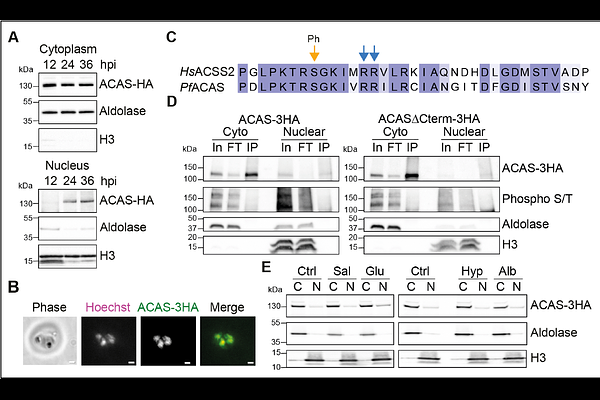
AbstractA complex transcriptional cascade drives the two-day intraerythrocytic developmental cycle of the most virulent human malaria parasite, Plasmodium falciparum, in the human host. Genes are rapidly activated at specific times, then silenced as quickly. Transcriptional activity correlates with histone acetylation, which is modulated by acetyltransferases that use acetyl-CoA and deacetylases that produce acetate. Acetyl-CoA synthetase (ACAS) uses acetate to produce acetyl-CoA and has been implicated in histone acetylation, providing an interesting link between parasite metabolism and transcription. Here, we show that ACAS becomes enriched in the nucleus at a time during the life cycle when the parasite undergoes rapid growth and increased levels of transcription. We use mass spectrometry to show that ACAS inhibition results in a rapid and global depletion of histone acetylation, which leads to a general decrease in chromatin accessibility at gene promoters. These widespread alterations in chromatin composition disrupted the transcriptional cascade, resulting in cell cycle arrest. Our study provides evidence that ACAS plays an important nuclear role in the histone acetylation cycle and insight into the dynamic nature and essentiality of histone acetylation in the parasite's complex transcriptional program driving infection of the human host.