Hybrid Tetramers of Wild-Type and Amyloidogenic H88R Transthyretin Challenge the Monomer Paradigm

Hybrid Tetramers of Wild-Type and Amyloidogenic H88R Transthyretin Challenge the Monomer Paradigm
Fazekas, Z.; Body, I.; Tar-Palfi, H.; Papp, D.; Virag, D.; Turiak, L.; Pozsonyi, Z.; Menyhard, D. K.; Perczel, A.
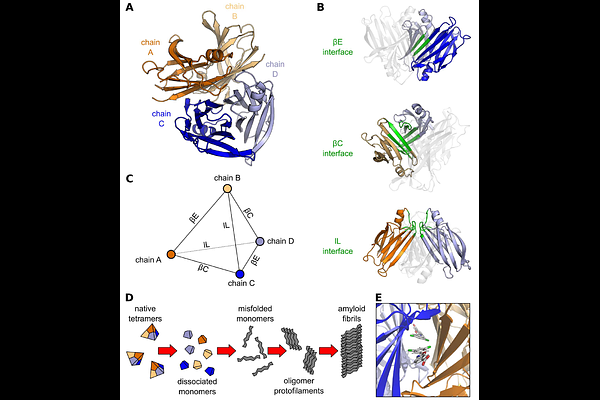
AbstractHereditary transthyretin amyloidosis (ATTRv) is driven by mutations destabilizing native tetrameric transthyretin (TTR) into amyloidogenic monomers. The H88R variant is considered fully monomeric, but its behavior in heterozygous patients remains unclear. Here, we demonstrate that H88R TTR forms stable hybrid tetramers with wild-type chains in silico, in vitro and in patient sera. Analysis of these assemblies reveals that hybrid tetramers containing one or two mutant chains maintain wild-type-like stability, facilitating their secretion. Mass spectrometry confirms H88R incorporation into tetramers and detects low variant concentrations in carrier serum. We propose this scarcity results from endoplasmic reticulum retention and model H88R TTR association with the chaperone Binding immunoglobulin Protein (BiP). These findings revise the monomeric classification of H88R TTR, highlighting a balance between cellular retention and hybridization with direct implications for tetramer-stabilizing therapeutics in heterozygous ATTRv patients.