A five-dimensional functional state space for fingerprinting disease transcriptomes

A five-dimensional functional state space for fingerprinting disease transcriptomes
Nie, F.; Zhuang, Y.; Chen, K.; Lin, J.; Sun, J.
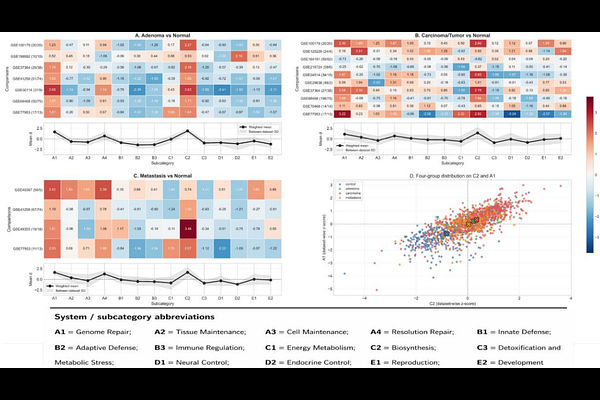
AbstractHigh-throughput transcriptomics has transformed disease biology, but its outputs often remain fragmented into gene and pathway lists that are difficult to compare across conditions or use for human-AI interpretation. We developed a five-dimensional (5-D) functional state space that represents disease transcriptomes as coordinated activity patterns across major biological systems. The framework maps transcriptomic signals onto five functional systems, 14 subcategories, and a distinct infrastructure layer, and was implemented as a reproducible pipeline for functional scoring, cross-condition profiling, benchmarking, and large language model (LLM)-assisted interpretation. Applied to wound healing, sepsis, colorectal cancer-related datasets, an extended GEO atlas of 38 complete case-control disease fingerprints spanning diverse disease contexts, and a TCGA-COAD/READ stage benchmark, the approach recovered interpretable disease-state patterns and retained progression-related information under strong compression. It also improved the quantitative grounding of LLM-generated summaries. This framework provides a compact and auditable representation for comparing disease transcriptomes and supporting human-AI biological interpretation.