Overlapping upstream ORFs repress translation and expand proteome diversity in Arabidopsis

Overlapping upstream ORFs repress translation and expand proteome diversity in Arabidopsis
Wu, H.-Y. L.; Cheng, Y.-H.; Kaufman, I. D.; Ai, Q.; Hsu, P. Y.
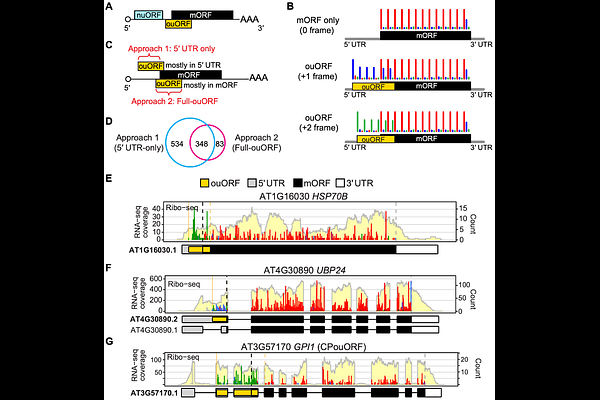
AbstractUpstream open reading frames (uORFs) are widespread cis-regulatory elements that modulate translation initiation of downstream main ORFs (mORFs). Among them, overlapping uORFs (ouORFs) that overlap with mORFs are predicted to exert the strongest translational repression, yet they remain largely unexplored because of the difficulty of their identification. Here, we developed complementary computational approaches to systematically identify translated ouORFs from super-resolution ribosome profiling data in Arabidopsis. We identified 965 translated ouORFs alongside 7,180 canonical non-overlapping uORFs (nuORFs). We found that ouORFs exert substantially stronger translational repression than nuORFs, and that this repression depends primarily on Kozak context rather than uORF length. In addition, genes containing ouORFs or nuORFs have weaker mORF Kozak contexts than genes without uORFs, which may further reduce mORF translation. Moreover, ouORF translation promotes initiation downstream of the annotated mORF start codon, generating N-terminally truncated protein isoforms with altered domain composition and subcellular localization. Using ATPS2 as an example, we demonstrate that ouORF translation regulates alternative translation initiation to control the balance between chloroplast and cytosolic protein isoforms. Together, our findings establish ouORFs as a versatile class of translational regulatory elements that coordinate both protein abundance and protein diversity, providing the first genome-wide characterization of translated ouORFs in plants.