The Disease Gene THAP12 is a Transcriptional Regulator of Mitochondrial ETC Complex I

The Disease Gene THAP12 is a Transcriptional Regulator of Mitochondrial ETC Complex I
Desousa, B. R.; Abe, Y.; Kampmann, M.; Jain, I. H.
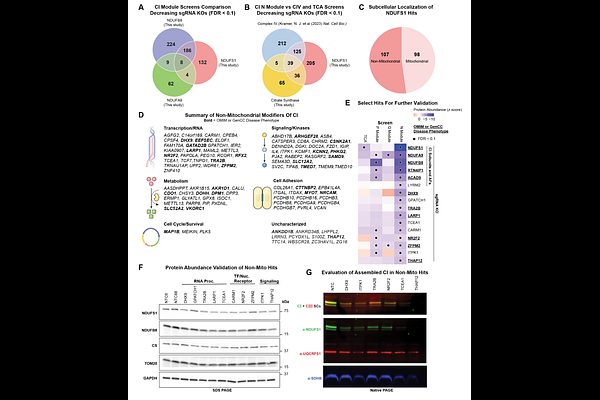
AbstractComplex I (CI) is the largest and most disease-associated component of the mitochondrial electron transport chain. While many diseases are linked to defects in specific CI subunits, the extent to which non-mitochondrial proteins contribute to CI function or disease is less clear. Here, we perform genome-wide CRISPR screens to identify regulators of CI abundance across its N, Q, and P modules, which mediate NADH oxidation, quinone reduction, and proton pumping, respectively. These screens identify THAP12 as a previously unrecognized transcriptional regulator of CI biogenesis. THAP12 loss selectively destabilizes CI and impairs oxidative ATP production. Mechanistically, THAP12 functions in the nucleus as a DNA-binding factor that directly activates genes required for CI assembly and iron-sulfur cluster maintenance, including NDUFAF3, NDUFAF4 and BOLA3. Patient-derived fibroblasts carrying THAP12 mutations exhibit conserved transcriptional defects and profound CI deficiency, establishing THAP12-associated neurodevelopmental disorder as a secondary mitochondrial CI disease. Finally, hypoxia rescues growth defects in THAP12-deficient cells, nominating low-oxygen therapy as a potential treatment strategy. Together, these findings identify THAP12 as a dedicated regulator of CI assembly and expand the genetic landscape of CI disease.