Hepatobiliary Progenitor-like Reprogramming in Liver Metastases

Hepatobiliary Progenitor-like Reprogramming in Liver Metastases
Sharma, A. K.; Takahashi, N.; Cao, Y.; Joshi, A.; Zhuang, S.; Kazi, A.; Nirula, M.; Sahoo, S.; Zhang, Y.; Kumar, R.; Subhadarshini, S.; Parmar, K.; Mikolaj, M.; Shreshta, R. L.; Assadpour, T.; Chrisafis, G.; Desai, P.; Alahmadi, A.; Chen, H.-Z.; Nicholas, S.; Huang, Y.; Thomas, M. S.; Lake, R.; Sanghvi, N.; Nair, N.; Mukherjee, N.; Dhaka, B.; Febres Aldana, C. A.; Radhakrishnan, S.; Friedman, N.; Brown, G. T.; Kleiner, D. E.; Difilippantonio, S.; Owen, D. H.; Andersson, T.; Ruppin, E.; Narayan, K.; Jolly, M. K.; Hewitt, S.; Thomas, A.
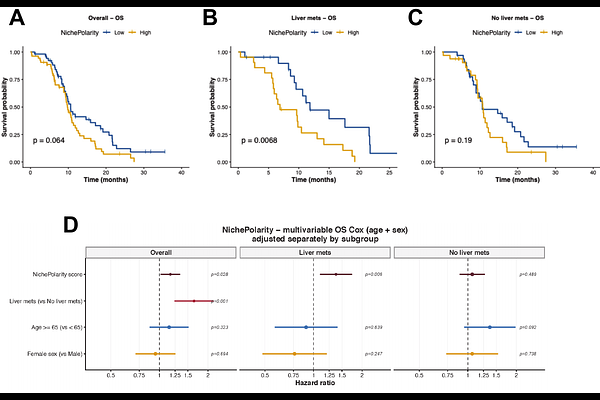
AbstractMetastatic progression requires cancer cells to adapt to the unique constraints of distant organ microenvironments, yet the mechanisms that drive organ-specific adaptations remain poorly understood. Here, we show that the liver actively rewrites metastatic cancer cell identity, driving tumor cells toward a hepatobiliary progenitor-like state. Through integrated transcriptomic, proteomic, metabolomic, and epigenomic analyses of patient-derived rapid-autopsy samples and experimental models, we identify this state as selectively enriched in liver metastases. It is characterized by co-activation of hepatic and biliary/progenitor regulators HNF4A and SOX9 and is observed across multiple epithelial cancers, indicating a conserved response to the hepatic niche. Mechanistically, hepatocyte-derived TGF-{beta} and hypoxia converge to activate a HIF-1-ACLY axis, increasing nuclear acetyl-coenzyme A availability and histone acetylation at hepatic lineage regulatory elements to drive hepatobiliary reprogramming. This coordinated niche-response program can be captured transcriptionally and is associated with inferior overall survival. Disruption of this pathway suppresses hepatic reprogramming and impairs liver metastatic fitness. These findings identify the liver as an active determinant of metastatic cell fate, linking microenvironmental signaling to metabolic and chromatin remodeling programs that enable lineage plasticity. More broadly, they reveal organ-specific reprogramming as a fundamental principle of metastasis and a therapeutic vulnerability in liver metastases.