Leveraging Homologous Recombination Deficiency via the Repositioned Prodrug CB1954

Leveraging Homologous Recombination Deficiency via the Repositioned Prodrug CB1954
Elia, J. L.; Hill, J.; Heer, C. D.; Smolev, S.; Sykes, A. M.; Arbelaez, S. R.; Lucas, K. N.; Johnson, S. S.; Sundaram, R. K.; Herzon, S. B.; Bindra, R. S.
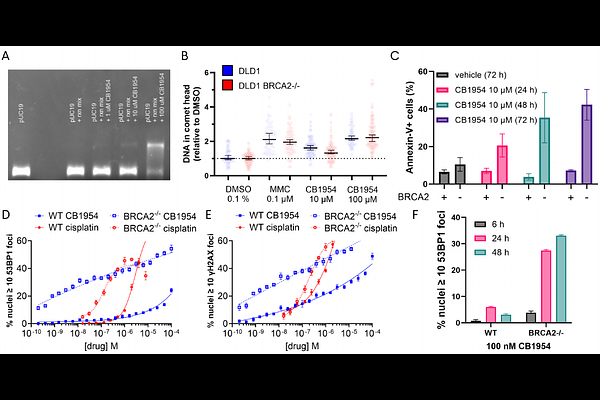
AbstractHomologous recombination deficiency (HRD) is an actionable vulnerability found in a substantial fraction of human cancers, yet current HRD-directed therapies are limited by toxicity, incomplete responses, and acquired resistance. Many DNA-damaging agents were developed before DNA repair biomarkers were available, suggesting that abandoned agents may harbor previously unrecognized genotype-selective activity. Here, through a focused screen of DNA-damaging agents in isogenic homologous recombination-proficient and -deficient models, we identify CB1954, a decades-old nitrobenzamide aziridine prodrug, as highly selective for BRCA2-deficient tumor cells. CB1954 forms DNA interstrand crosslinks independent of HR status, but selectively induces DNA-damage signaling, apoptosis, and loss of clonogenic survival in HR-deficient cells. Targeted DDR CRISPR screening and isogenic validation define a distinct repair dependency for the Fanconi anemia and homologous recombination pathways, with limited dependence on mismatch repair or nucleotide excision repair. Genetic and pharmacologic perturbation of NQO2, the bioactivating enzyme for CB1954, reveals a bifurcated mechanism in which NQO2-dependent activation selectively contributes to HRD cytotoxicity, while aziridine-dependent lesions likely account for residual activity in HR-proficient cells. CB1954 exhibits favorable preclinical pharmacokinetic properties and genotype-dependent antitumor activity in BRCA2-deficient xenografts. These findings reposition CB1954 as a historically overlooked HRD-selective agent and demonstrate that biomarker-guided profiling of DNA-damaging agents can uncover new opportunities for precision oncology.