Computational Design and Atomistic Validation of a High-Affinity VHH Nanobody Targeting the PI/RuvC Interface of Streptococcus pyogenes Cas9: A Bivalent Hub Strategy for CRISPR-Cas9 Enhancement

Computational Design and Atomistic Validation of a High-Affinity VHH Nanobody Targeting the PI/RuvC Interface of Streptococcus pyogenes Cas9: A Bivalent Hub Strategy for CRISPR-Cas9 Enhancement
Kumar, N.; Dalal, D.; Sharma, V.
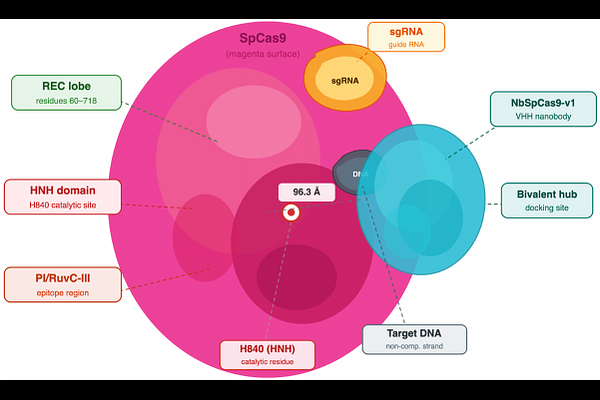
AbstractThe CRISPR-Cas9 system has revolutionized genome engineering, yet its full therapeutic potential remains constrained by challenges in precisely modulating its activity and specificity. Here we report a fully computational end-to-end pipeline for the de novo design of a single-domain VHH nanobody (NbSpCas9-v1) targeting a structurally conserved, non-catalytic epitope at the PAM-interacting (PI) and RuvC-III interface of Streptococcus pyogenes Cas9 (SpCas9; PDB: 4UN3). Nanobody sequences were generated using BoltzGen, a generative diffusion binder design framework, and co-folded with SpCas9 using Boltz-2 to evaluate structural confidence and binding affinity. The top-ranked model (SpCas9_4UN3_Bivalent_Hub_v1) achieved a complex pLDDT of 0.8406, an aggregate score of 0.8016, and an ipTM of >0.8, indicating high confidence in the nanobody antigen interface. The designed 1,616-residue quaternary complex was subjected to 10 ns of all-atom molecular dynamics simulation using the AMBER14SB force field within the GROMACS/OpenMM framework. The complex stabilized at RMSD approximately 6 Angstrom with a radius of gyration of 39 to 44 Angstrom, confirming thermodynamic stability under physiological conditions (310 K, 0.15 M NaCl). A conserved 96.3 Angstrom inter-molecular distance between the nanobody centroid and the HNH catalytic residue H840 establishes NbSpCas9-v1 as a distal, non-inhibitory binder ideally suited for a Bivalent Hub architecture recruiting secondary effectors to the Cas9 ribonucleoprotein. These results provide a rigorous structural and dynamic foundation for experimental validation of VHH-based CRISPR-Cas9 enhancers and modulators.