Machine Learning-Guided Engineering of High-Affinity Cross-Reactive Antibodies with Minimal Mutations

Machine Learning-Guided Engineering of High-Affinity Cross-Reactive Antibodies with Minimal Mutations
Hugo, D.; Grindel, A.-L.; Thenier, F.; Pluchart, C.; Munch, M.; Oliveira, C.; Dubois, S.; Le Drezen, C.; Guerois, R.; Maillere, B.; Truillet, C.; Nozach, H.
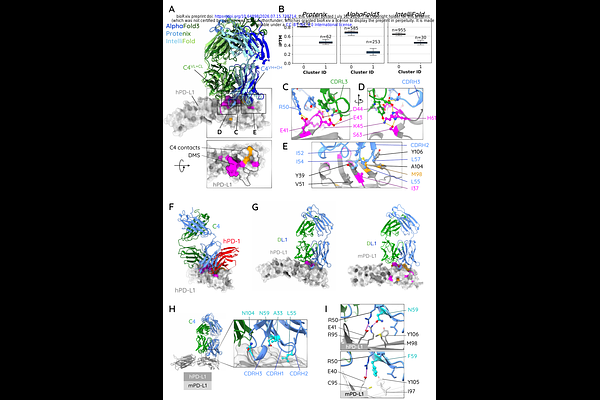
AbstractAntibodies raised against human targets often fail to recognize their animal orthologs, limiting preclinical evaluation in relevant models. We developed a Deep Mutational Scanning (DMS)-coupled deep learning strategy to engineer potent cross-reactive antibodies with minimal sequence divergence. Starting from C4, a fully human anti-PD-L1 antibody with weak recognition of murine PD-L1, DMS identified substitutions that improved binding to both human and mouse antigens. Conventional recombination of beneficial mutations generated highly cross-reactive antibodies but required 13 to 15 substitutions. To reduce this mutational burden, a deep learning model trained on DMS-derived sequence-binding data was used to identify minimal mutation combinations predicted to retain high affinity. This approach yielded variants carrying only 4 to 5 substitutions, with in vitro and cellular binding properties comparable to highly mutated antibodies. Epitope mapping, structural modeling and in vivo assessment further confirmed that these engineered antibodies retained PD-1/PD-L1 blockade and demonstrated therapeutic activity in a mouse tumor model.