Whole-genome pre-amplification as a viable approach for genomic screening of FFPE-derived DNA samples

Whole-genome pre-amplification as a viable approach for genomic screening of FFPE-derived DNA samples
Guerrero Quiles, C.; Lodhi, T.; Sellers, R.; Sahoo, S.; Weightman, J.; Breitwieser, W.; Sanchez Martinez, D.; Bartak, M.; Shamim, A.; Lyons, S.; Reeves, K.; Reed, R.; Hoskin, P.; West, C.; Forker, L.; Smith, T.; Bristow, R.; Wedge, D. C.; Choudhury, A.; Biolatti, L. V.
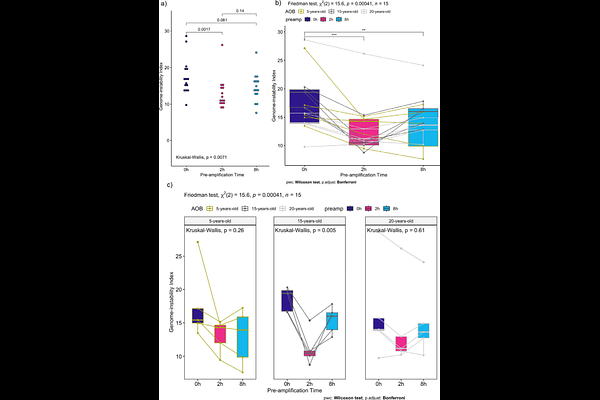
AbstractWhole-genome sequencing (WGS) enables comprehensive analysis of tumour genomes, but its use in formalin-fixed paraffin-embedded (FFPE) samples is limited by DNA fragmentation and low yields. Whole-genome amplification (WGA) methods such as multiple displacement amplification (MDA) can boost DNA availability but distort copy-number alteration (CNA) profiles. DNA ligation-mediated MDA (DLMDA) mitigates this bias by reconstituting fragmented templates, yet its performance in FFPE-derived DNA remains uncertain. We compared paired DLMDA pre-amplified (2h, 8h) and non-pre-amplified FFPE prostate tumour samples from 22 archival blocks (5, 15 and 20 years old). DLMDA increased DNA yield by 42- to 86-fold, with global CNA patterns largely preserved. However, DLMDA significantly reduced the number of detected CNA deletions and amplifications. These effects were independent of both block age and reaction time. CNA dropouts were randomly distributed across the genome, indicating that DLMDA does not introduce regional bias. Our results show that DLMDA enables robust DNA yield recovery and avoids false-positive CNA artefacts, but at the cost of reduced CNA sensitivity. While suitable for CNA screening pipelines through WGS, further improvements are required to minimise the false-negative risk and improve the technique's sensitivity for FFPE-based genomics.