Transcriptionally defined AML cell states associate with treatment response and microenvironmental remodeling

Transcriptionally defined AML cell states associate with treatment response and microenvironmental remodeling
Struyf, N.; Hartmanis, L.; Rico Pizarro, L.; Österroos, A.; Bohlin, A.; Bengtzen, S.; Lehmann, S.; Kallioniemi, O.; Erkers, T.
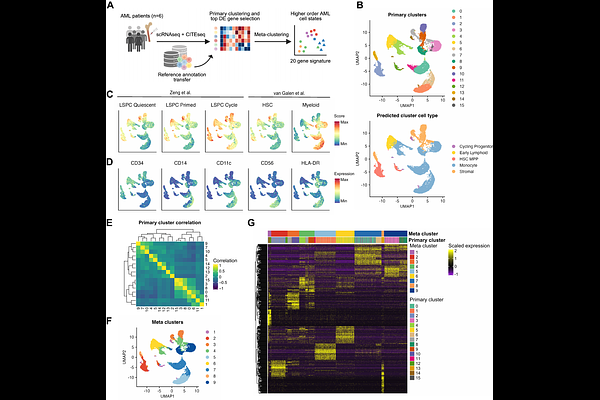
AbstractWhile therapy resistance in acute myeloid leukemia (AML) is often attributed to leukemic stem cells (LSCs), their functional properties are not fully captured by their well-established genetic landscape and cell lineage transcriptional programs. Here, we explore AML cell states and their associations to drug response and systemic immune context. We performed integrated single-cell transcriptomics and immunophenotyping on diagnostic AML samples (n=6) to define transcriptional cell state gene signatures. These were projected onto bulk RNA-seq data from 448 AML patients to assess associations with drug sensitivity, plasma proteomics, clinical features, and established prognostic scores. Longitudinal single-cell data from external cohorts and cell-cell communication analyses were used to examine treatment dynamics and microenvironmental signaling. We defined nine AML cell states, including progenitor-like, stromal-like, antigen-presenting, and monocytic programs. Stemness features were distributed across multiple states, with lymphoid-primed and stress-adapted progenitors showing the strongest alignment with established stemness scores. Distinct drug sensitivities emerged, including cell cycle checkpoint inhibitor sensitivity in stress-adapted progenitors and kinase inhibitor sensitivity in cycling progenitors, alongside shared resistance to BH3 mimetics in monocytic states. Stress-adapted progenitors were associated with adverse clinical features and expanded following venetoclax-based therapy. Monocytic states acted as immunosuppressive hubs via TIGIT signaling, while stromal-associated states received niche-derived survival signals. Overall, we define a framework that associates AML cell states with stemness, drug response, and microenvironmental interactions. These findings highlight distributed stemness, state-specific vulnerabilities, and niche-driven resistance mechanisms, informing more precise therapeutic strategies in AML.