A non-enzymatic role for METTL3 as an Androgen Receptor co-regulator that promotes prostate cancer proliferation.

A non-enzymatic role for METTL3 as an Androgen Receptor co-regulator that promotes prostate cancer proliferation.
Kostlan, R. J.; Phoenix, J. T.; Budreika, A.; Ferrari, M. G.; Deegan, C. F.; Warren, E. T.; Bawa, P. S.; Rogers, C. S.; Dureja, D.; Ali, M.; Hancock, G. R.; Young, K. S.; Gupta, G.; Solanki, A.; Vander Griend, D. J.; Fanning, S. W.; Kregel, S.
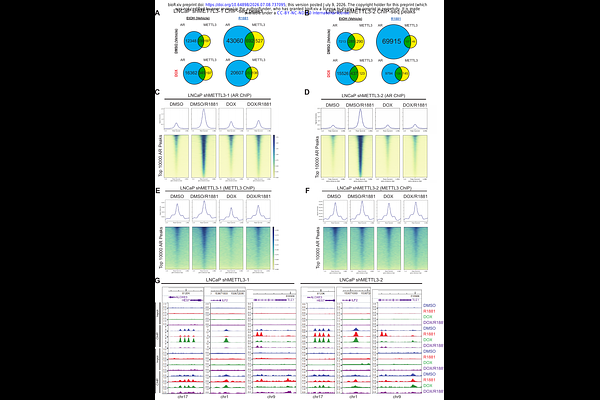
AbstractMetastatic prostate cancer (PCa) continues to be a major cause of death in males, despite advances in treatment. Most treatment focuses on targeting the Androgen Receptor (AR), the main oncogene responsible for driving most prostate tumors. Despite these therapies targeting AR, the majority of patients still succumb to AR-driven disease. Therefore, there is a critical need for understanding how AR functions to promote prostate cancer growth and identify alternative therapeutic targets in AR-driven PCa. One avenue garnering attention is targeting epigenetic regulators that promote AR-activity; however, the importance of epitranscriptomic regulators, like those that modify mRNAs, is not well understood. Here, we identify a new role for the key catalytic subunit of the RNA N6-methyladenosine (m6A) transferase complex, METTL3, as an AR-coregulator. METTL3 is overexpressed in prostate tumors compared to normal tissue, and METTL3 protein is elevated in AR-expressing cell lines. Depletion of METTL3 significantly reduces proliferation of cancer cells and has no effect on the growth of non-transformed prostate epithelial cells, despite decreasing global m6A levels on mRNA. The catalytic activity of METTL3 is dispensable for the growth of both non-transformed and PCa cell lines, as pharmacologic inhibition of METTL3 does not inhibit proliferation, despite the reduction of global m6A on mRNA. Overexpression of both wild-type and catalytically inactive METTL3 mutants enhances cell viability and rescues cells in which METTL3 is knocked down. Finally, we report on direct interaction between AR and METTL3, their co-localization on chromatin, and reduced AR-cistromic occupancy within cells with METTL3 knockdown. Together, these findings identify a non-enzymatic role for METTL3 in supporting AR-driven transcriptional programs and PCa proliferation.