Validation and analysis of 12,000 AI-driven CAR-T designs in the Bits to Binders competition

Validation and analysis of 12,000 AI-driven CAR-T designs in the Bits to Binders competition
Kosonocky, C. W.; Abel, A. M.; Feller, A. L.; Cifuentes Rieffer, A. E.; Woolley, P. R.; Lala, J.; Barth, D. R.; Gardner, T.; Ekker, S. C.; Ellington, A. D.; Wierson, W. A.; Marcotte, E. M.
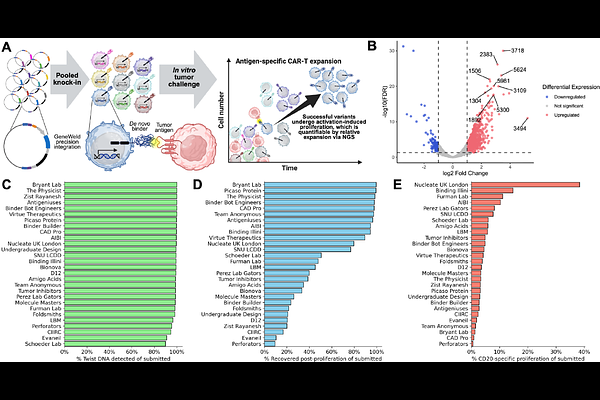
AbstractArtificial intelligence (AI) methods for proteins have advanced rapidly, improving structure prediction and design, particularly for de novo binders. However, most evaluations emphasize binding affinity rather than higher-order biological function. We present Bits to Binders, a global competition benchmarking de novo binder design in the context of chimeric antigen receptor (CAR) T cells. Teams from 42 countries submitted 12,000 designs of 80-amino acid binders targeting human CD20 as CAR binding domains. Designs were screened by pooled CAR-T proliferation, identifying 707 designs exhibiting significant CD20-specific enrichment, with team hit rates from 0.6% to 38.4%. Top-performing candidates were validated as individual constructs, measuring CD20-specific proliferation, expansion, cytokine production, and targeted cell lysis. We identified common design methodologies and factors correlated with DNA synthesis, expression, and target-specific T cell activation which nearly double the success rates when applied as a retrospective filter. We release this dataset as an open resource, with practical recommendations to support more effective AI-driven binder design.