Methodological assessment of PDMS passive sampling for skin VOC collection across body sites

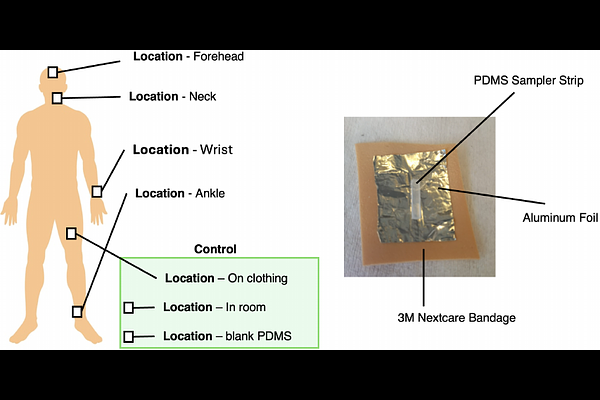
Methodological assessment of PDMS passive sampling for skin VOC collection across body sites
Kobara, S.; Huang, M.; Ilhamsyah, R.; Struk, D.; Dimandja, J.; Hesketh, P. J.; Arrubla, D. C.; Fensore, C.; Polito, C.; Kamaleswaran, R.; Esper, A.
AbstractBackground: Polydimethylsiloxane (PDMS) is a non-invasive and versatile material often used for non-invasive collection of skin-emitted volatile organic compounds (VOCs), with potential applicability in acute and pre-critical care settings. However, most existing PDMS-based methodologies rely on extensive sample preparation and environmental control, limiting their feasibility in time-sensitive clinical contexts. Methods: We conducted a proof-of-concept pilot study in four healthy volunteers to evaluate whether a simplified skin-contact PDMS sampling procedure can capture detectable VOCs and preserve individual-level variation. PDMS strips were applied directly to the skin with minimal preparation, and collected VOCs were analyzed using gas chromatography-mass spectrometry. Donor-associated variability was assessed using Bray-Curtis dissimilarity, and variability in VOC detection was evaluated across body sites. Results: Skin-contact PDMS sampling detected 160 VOCs across four participants. The mean within-donor Bray-Curtis dissimilarity was 0.308, compared with a mean between-donor dissimilarity of 0.347. Preliminary permutation testing showed distinguishable donor profiles (p-value = 0.004). VOC detection variability differed across body sites, with lower coefficients of variation at the forehead, neck, and wrist than at the ankle. Conclusions: Under simplified sampling conditions, skin-contact PDMS captured individual-associated VOC profiles with lower within-donor variability than between-donor variability. These findings support the feasibility of PDMS-based skin VOC sampling in minimally controlled settings. Further validation in larger and clinically relevant cohorts is warranted to assess the utility of PDMS-sampled skin VOCs as potential biomarkers for early disease detection.